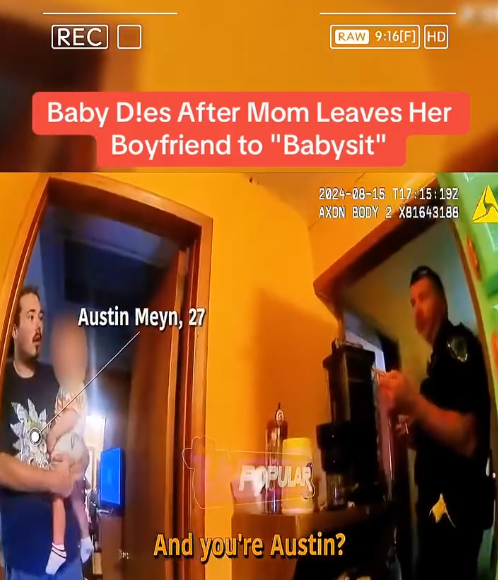
A fateful morning that began with a young mother’s misplaced trust ended in the piercing sirens of an ambulance and the mysterious death of an innocent baby not even four months old. Behind evasive statements, baffling discrepancies in the timeline, and unexplained bruising on young children lies a dark truth that investigators are now piecing together. Was this truly an unfortunate accident born of negligence, or does it conceal a far more sinister crime?
1. The Fateful Phone Call from a Locked House
The nightmare began when a young mother named Ashlen left for work at 6:30 AM, entrusting her two young children to her live-in boyfriend, 27-year-old Austin Myers. In the home were her two-year-old son, Alexander, and her youngest, Andrew, barely four months old. In the mother’s eyes, Austin was a reliable partner whom she believed she could trust with her children.
However, late that morning, Ashlen’s phone rang incessantly. On the other end of the line was Austin, frantically claiming that baby Andrew had suddenly become unresponsive, could not be woken up, and was completely limp. The phone call was placed at 11:54 AM and lasted a mere 53 seconds. Terrified, the mother rushed home from work in a panic, yet an eerie question immediately emerged: upon discovering an infant in critical condition, why was the caregiver’s first instinct to call the mother rather than dial emergency medical services immediately?
2. A Fatal Delay and Conflicting Timelines During the “Golden Hour”
When law enforcement and emergency personnel arrived, an overwhelming sense of dread hung over the cramped bedroom. The four-month-old infant had stopped breathing and was totally unresponsive. Through tears, the mother stated that upon arriving home and finding her baby lifeless on the bed, she moved him to the floor to begin CPR before finally calling 911.
Yet seasoned investigators immediately detected a critical gap in the timeline. Between Austin’s initial call at 11:54 AM and the moment emergency services were contacted, precious, life-saving minutes slipped away. When questioned as to why emergency services were not dialed the instant the child was found unresponsive, the mother broke down, admitting that calling 911 did not even cross their minds at first. An infant remaining unresponsive for several minutes without immediate professional intervention represented a devastating delay that severely diminished any slim hope of survival.
3. Mysterious Bruising on a Two-Year-Old’s Forehead
While the frantic mother was being questioned outside, officers entered the residence to speak with Austin. He was holding Ashlen’s older son, two-year-old Alexander. Projecting a calm demeanor, Austin referred to himself as the “stepdad” who was simply trying to do his best for the kids.
However, the investigator’s flashlight illuminated an alarming detail: a prominent, dark bruise on the two-year-old boy’s forehead. When pressed about the injury, Austin casually brushed it off, claiming the toddler was rambunctious, loved jumping on beds, and had sustained the bruise days prior. In a home with two young children—one now deceased and the other showing head injuries—this pattern immediately raised serious red flags of suspected domestic child abuse.
4. Reconstructing the Scene: A Depressed Mattress and the Suffocation Narrative
To determine how baby Andrew stopped breathing, detectives had Austin climb onto the bed to reenact the infant’s exact position. The boyfriend offered a seemingly plausible explanation: he claimed the baby had been fussy due to an upset stomach, so he placed him on his stomach for “tummy time” to relieve gas.
Pointing to the bare mattress, which featured circular indents and hollows, Austin suggested the infant’s nose might have gotten wedged into one of the depressions, leading to accidental suffocation. He maintained that he was simply lying on the bed browsing on his phone, checking on the baby every 10 to 15 minutes. He even presented a baby bottle that was still warm, stating he had prepared it just minutes before the baby became unresponsive. Every detail appeared carefully constructed to frame the tragedy as a tragic crib-style accident.
5. Bloodstains Uncovered in the Back of the Ambulance
Austin’s narrative began unraveling the moment inconsistencies surfaced in his story. He admitted that he had just returned from an exhausting two-day bus trip and was running on sheer fatigue. When pressed on whether he had fallen asleep and rolled over onto the child, Austin hesitantly conceded that his leg might have inadvertently rolled over the baby while he was half-asleep, though he claimed he could not be certain.
Simultaneously, inside the ambulance racing toward the hospital, paramedics were administering desperate life-saving measures on baby Andrew. Suddenly, bodycam footage captured a chilling discovery: emergency responders spotted blood on the infant. A paramedic pointed out visible blood underneath the child, suggesting potential blunt-force trauma or severe internal injury. The presence of blood shattered the theory of a benign, accidental suffocation.
6. Belated Tears and the Unraveling Truth at the Hospital
At the hospital emergency room, medical staff fought valiantly, but no miracle occurred. Doctors were forced to call the time of death, confirming that the four-month-old infant had passed away. Arriving at the hospital, the child’s biological father collapsed in agony, weeping uncontrollably while clinging to family members in profound grief. Nearby, the young mother sat numb on a hospital bed, her muffled sobs filled with anguish and regret.
In the hallway, investigators secured the area, preparing to photograph the infant’s body for forensic evidence before the parents entered to say their final goodbyes. Outside, an officer walked up to Austin Myers and delivered a stern directive: “There is a great deal of concern right now regarding what happened…”. The man’s calm facade began to crumble in the face of mounting physical evidence. What had been reported as a medical emergency officially escalated into a criminal investigation into child abuse resulting in death.
LESSONS FROM THE TRAGEDY
This heartbreaking case serves as an urgent reminder and a cautionary tale for families and caregivers:
- Never leave vulnerable infants with irresponsible individuals: Infants are completely defenseless and cannot call for help. Leaving babies in the care of new partners, acquaintances, or anyone whose temperament, patience, and character have not been thoroughly proven poses an immense and potentially fatal risk.
- Never overlook subtle signs of physical trauma: Unexplained bruising or injuries on young children—such as the mark observed on the toddler’s forehead—must never be dismissed as mere clumsiness. These marks are often critical early warnings of neglect or ongoing abuse.
- The vital importance of the “Golden Hour” in medical emergencies: If an infant is found unconscious or unresponsive, dialing emergency services immediately is the paramount priority. Any delay, hesitation, or attempt to manage the situation privately robs the child of critical resuscitation opportunities and carries grave legal consequences.