What began as a routine knock on an apartment door quickly descended into a harrowing firefight when a dark barrel suddenly opened fire from the shadows. At point-blank range, the line between life and death had never been thinner. This is how apartment number 16 transformed into a fortified battleground during ten grueling hours.
1. The Smothered Silence of the Hallway
Darkness settled over the aging apartment complex on 3rd Avenue North. In stark contrast to normal evening routines, the second-floor corridor felt suffocatingly quiet, broken only by the deliberate, measured footsteps of local patrol officers.
The initial assignment was a standard compliance check and warrant service on a suspect named Nathaniel. Yet, outside unit 16, the dead silence behind the locked wooden door raised immediate flags. Seasoned instincts warned the team that this was no longer a routine arrest; a volatile threat lurked just inches away on the other side.
2. A Muzzle Flash at Point-Blank Range
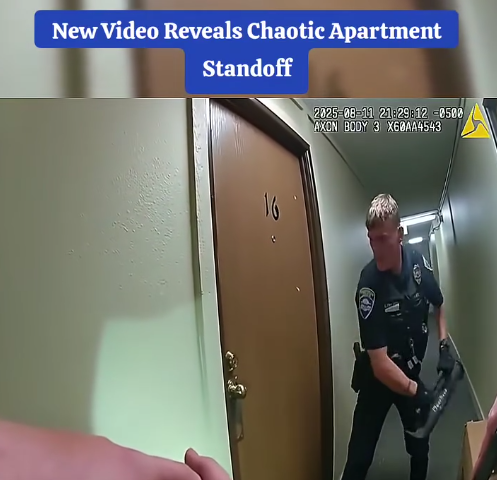
When repeated knocking and loud commands yielded no response, the officers initiated a forced entry. A tactical halligan bar bit deep into the door frame, leveraging enough force to pop the latch.
Weapon lights pierced the gloom inside, catching the silhouette of a stationary figure. The lead officer shouted clear commands: “Nathaniel, hands up! Open the door and step out right now!”
The response was not compliance. Through the widened breach, an arm suddenly thrust forward, leveling a black handgun directly at the stack. BANG! A single, sharp blast ruptured the tight corridor. The round struck the point officer directly in the chest from mere inches away.
“Shots fired! Shots fired!” crackled frantically over the radio as the team scrambled backward, pulling their struck teammate into a corner to form a protective perimeter. The round had caught the officer square in the body armor—the Kevlar stopped the bullet, saving his life by a fraction of an inch. The situation had escalated into an active, lethal standoff.
3. Human Shields Behind the Barricade
Just as officers secured the outer perimeter, urgent intelligence from dispatch escalated the crisis to its peak: the armed suspect was not alone. Innocent young children were inside the apartment.
The suspect had turned his own family into human shields, barricading himself in the darkened rooms with a lethal arsenal. Conventional breach tactics—such as heavy suppressive fire or CS gas canisters—were immediately ruled out due to the extreme danger to the children. Every minute outside became a tense psychological war of patience and restraint.
4. SWAT Mobilization and High-Stakes Containment
Recognizing the catastrophic threat, the Red River Valley SWAT team deployed to the scene. The perimeter expanded to lock down the entire block, with tactical snipers securing high-angle overwatch positions on neighboring rooftops.
Equipped with ballistic shields and carbines, tactical operators methodically cleared and locked down the hallway. PA systems broadcasted continuous appeals: “Occupants of apartment 16, you are surrounded! Lay down your weapons and exit immediately for the safety of the children!” The only answers were stony silence and the sharp, deliberate sound of firearms being cycled inside.
5. The Breach and Child Extraction
With negotiations completely stalled and the suspect showing increasing signs of agitation, commanders made the call to breach to safeguard the hostages. Using specialized heavy breaching equipment, operators forced the entry point once more.
SWAT operators advanced in a tight line, using heavy ballistic shields to form a moving corridor under immediate threat of gunfire. Utilizing a tactical diversion to pin down the suspect’s attention, an extraction team swiftly pushed into an adjoining room. They secured the terrified, crying children, passing them back along the shield line and safely out into the corridor. The extraction took only seconds, eliminating the barricade’s primary leverage.
6. The Fatal Climax of a 10-Hour Standoff
With the hostages secured, the barricaded subject realized his position was compromised. Rather than surrendering, he opened fire directly on the tactical stack in a desperate bid to force an exit.
Faced with imminent lethal danger, SWAT operators returned precision fire to neutralize the threat. A volley of rounds ended the resistance immediately. Two armed suspects inside were pronounced deceased at the scene, bringing the exhausting ten-hour siege to a close.
The aftermath left a hallway scarred by bullet impacts, shattered drywall, and a lingering question: what drove the suspect to push a routine warrant service to such a fatal, catastrophic extreme?