Disturbing Incident in the United States: Police Arrive at a Home, Raising Questions About What Happened Behind Closed Doors
Genre: Reconstructed crime feature
Hypothetical location: Houston, Texas, United States
Hypothetical time: A morning in June 2025
1. An Unusual Morning in a Quiet Houston Suburb
One morning in June, a quiet residential neighborhood on the outskirts of Houston, Texas, appeared to be going about its usual routine. Small streets connected rows of houses, cars occasionally passed by, and residents began another day filled with familiar activities. From the outside, there was little to distinguish the neighborhood from thousands of other residential communities across the United States.
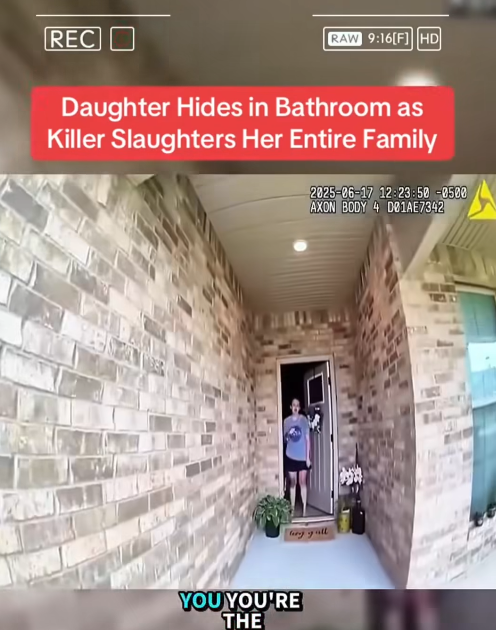
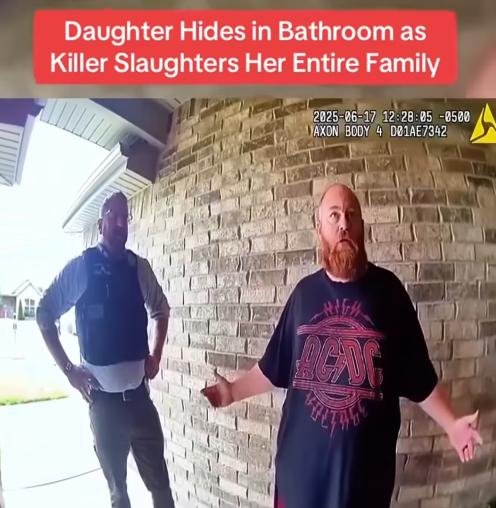
However, footage from a video later circulated online brought viewers to the entrance of a house, where police officers were seen speaking directly with a man. The encounter took place near the front door, in an otherwise ordinary setting that attracted attention because of the presence of law enforcement.
In the video, an officer approaches the entrance and begins speaking with the man standing in or near the doorway. The camera focuses on their interaction as the officer appears to observe the surrounding area. Another officer also appears in subsequent footage, prompting viewers to question why law enforcement had come to the property.
What brought the officers to this address? Were they conducting a routine welfare check, verifying information provided by a resident, or responding to something more serious?
The video does not provide enough information to answer these questions. Nevertheless, the unanswered details encourage viewers to examine each moment in an attempt to understand what may have happened.
Notably, the red headline displayed on the video makes a particularly serious allegation: a daughter allegedly hid in a bathroom while a killer murdered her entire family. This is a shocking claim, but it is also one that requires careful verification. The available footage alone does not establish that the entire story described in the headline is accurate.
2. Police Arrive at the Door as the Conversation Draws Attention
According to the visible footage, the encounter begins when an officer approaches the entrance and speaks directly with the man. Rather than presenting a wide view of the entire property, the video primarily focuses on the people standing near the doorway, allowing viewers to observe their interaction.
In many law enforcement situations, speaking directly with someone at a location is an important step in gathering information. Officers may need to establish identities, determine who is inside a residence, or assess whether anyone could be in danger.
However, the presence of police outside a house does not automatically establish that the homeowner or the person standing at the door has committed a crime. Determining what actually happened requires additional information about the reason for the visit, the conversation itself, and the outcome of the encounter.
In the video, the conversation continues as the officer remains focused on the man. The entrance becomes the central point of attention, while the most important questions remain unanswered.
For viewers, this uncertainty can easily lead to speculation. Some may associate the encounter with a serious criminal investigation, particularly after reading a headline describing the alleged killing of an entire family. Nevertheless, drawing conclusions without sufficient evidence can lead to inaccurate assumptions.
For that reason, the most reasonable approach is to distinguish between what the footage actually shows and what the headline claims.

3. A Tense Encounter at the Front Door Leaves Questions Unanswered
As the footage continues, viewers can see the officer and the man speaking near the entrance. The camera does not reveal everything happening inside the residence, nor does it provide the full context that led to the encounter.
This is a common limitation of short clips taken from police body-worn cameras. Such devices record only what falls within the officer’s field of view. Conversations occurring outside the frame, as well as events that took place before recording began, may be entirely absent.
Furthermore, videos circulated online may have been edited to emphasize moments considered particularly compelling. Without access to the complete recording, viewers may struggle to establish the full sequence of events.
In an actual criminal investigation, officers may need to consider several factors before deciding what to do next. They must assess the reliability of the information they have received, evaluate potential risks to those involved, and comply with legal requirements governing entry into or searches of private property.
However, there is insufficient evidence to conclude that these specific procedures took place in the video under discussion. What can be stated cautiously is that officers interacted with a man at the entrance, while the reason for and outcome of that encounter remain independently unverified.
Consequently, rather than immediately treating the footage as the beginning of a murder investigation, viewers should wait for more reliable information before reaching a conclusion.
4. Images Inside the House Raise Further Questions
After showing the encounter outside, the video moves to scenes inside the residence. Several people appear in the footage, but their faces are blurred, making it impossible to establish their identities, ages, or relationships with one another.
The change in setting naturally raises additional questions. Are the people shown inside connected to the initial encounter? Is the residence a family home where someone may have needed assistance? Was anyone injured or in danger? Or does the footage depict a situation entirely different from what viewers might imagine after reading the headline?
All these questions require further information.
In particular, the English headline refers to a daughter who allegedly took refuge in a bathroom while a killer attacked her family. If this detail were confirmed in a real criminal case, it would be an important element for investigators to establish, as it concerns the safety of someone who may have witnessed the incident.
However, the available images do not provide sufficient evidence to determine whether the girl described in the headline actually appears in the video. Nor is it possible to conclude that a multiple-homicide incident occurred at the residence being filmed.
Distinguishing between a headline’s claims and the actual footage is particularly important in crime reporting. A statement may be shocking, but the seriousness of an allegation does not replace the need for evidence.
Without police records, official statements, or reliable journalistic sources confirming the details, claims concerning the victims and suspect must remain unverified.
5. Why Can a Police Encounter at a House Attract Public Attention?
For many readers, videos documenting police activity in the United States are particularly compelling because they offer a closer look at real-world encounters. Instead of reading only a brief news report, viewers can observe how officers approach residents, communicate at a scene, and respond to situations whose circumstances may not immediately be clear.
When a video is accompanied by a headline describing a murder or a family tragedy, public interest can increase even further. Viewers naturally want to know who was responsible, what motivated the incident, and whether anyone survived.
However, this interest also creates a risk of misunderstanding when important context is missing. A video may show officers entering a house, but that does not necessarily prove they are investigating a murder. Similarly, footage of a man standing at a doorway does not establish that he is a suspect.
On social media, short, emotionally charged headlines often attract considerable attention. Nevertheless, responsible reporting must address several fundamental questions: Where did the incident occur? When did it happen? Who confirmed the information? And what evidence supports the conclusions being presented?
If these questions remain unanswered, an article should clearly acknowledge the limitations of the available information rather than adding imagined details as though they had been confirmed by investigators.
6. What Can Police Body-Camera Footage Actually Reveal?
Body-worn cameras, commonly known as bodycams, can provide valuable records of police activities. Depending on local regulations, the footage may help document interactions with members of the public, clarify the sequence of events, and support investigations.
Nevertheless, these cameras do not always capture an entire incident. Their field of view is limited, audio may be unclear, and events occurring behind the officer may not be recorded. In addition, videos circulating online frequently contain only excerpts from much longer recordings.
For example, an encounter at a front door may have followed an emergency call, a welfare-check request, or an incident reported earlier. If the beginning of the encounter is missing, viewers may have no way of knowing why officers arrived at the property.
Similarly, footage recorded inside a house must be interpreted within its broader context. Seeing several people in a room is not enough to establish who owns the residence, who is related to whom, or who may be connected to an investigation.
For this reason, journalists using bodycam footage should establish the recording’s origin, the time it was made, and which details have been confirmed by the relevant authorities. If this information is unavailable, the article should openly acknowledge those limitations.
This is not merely a matter of accuracy. It is also a way to protect people who could otherwise be identified or wrongly accused online.
7. Details That Must Be Verified Before the Incident Can Be Described as a Murder Case
Confirming the story presented in the headline requires considerably more information than the short video provides.
First, the location must be established. Houston, Texas, can be identified as the actual location only if a reliable source confirms it. Otherwise, attaching the city’s name to the story could mislead readers into believing that a documented crime occurred there.
The timing must also be verified. The date a video is uploaded is not necessarily the date the incident occurred. A recording may be reposted months or even years later, meaning the upload date cannot automatically be treated as the date of the alleged crime.
More importantly, information about the people involved must be established. Reliable sources would need to confirm whether anyone died, how many people were affected, the identity of any suspect, and the condition of any survivors. Such information generally needs to be checked against official police statements, court records, or reputable news organizations.
Finally, the relationship between the footage and the headline must be examined. The headline may describe a different story, the video may have been separated from its original context, or the content may have been published primarily to attract views. Without additional evidence, it is impossible to determine which explanation, if any, applies.
Until these issues are clarified, the most accurate description remains that the video shows police officers interacting with a man at a home’s entrance, followed by footage from inside the residence.
8. Lessons From Crime Stories Circulating Online
A serious crime, if it has actually occurred, is more than a story that captures public curiosity. Behind such an incident may be victims, grieving relatives, and people who must cope with lasting consequences.
For that reason, spreading unverified information can have significant effects. An innocent person may become the target of suspicion, a family may experience unwanted attention, or an ordinary address may become associated with a crime that has never been substantiated.
For readers, the best approach is to check the source before sharing a story, pay attention to the publication date, and look for confirmation from multiple independent sources. If an article relies solely on a sensational headline without providing verifiable evidence, its conclusions should be treated cautiously.
Writers and publishers have an even greater responsibility. A headline may be compelling and the storytelling may be dramatic, but neither should change the underlying facts. Hypothetical details must be clearly distinguished from information that has been confirmed.
In addition, people who may be victims or witnesses deserve protection of their privacy, especially when their identities have not been officially released.
Responsible reporting does not mean avoiding difficult or disturbing subjects. Rather, it means presenting them with care, accuracy, and respect for the people involved.
9. Conclusion: Questions Remain After the Video Ends
The video opens with images of police officers approaching a house and speaking with a man at the entrance. It then shows additional scenes inside the residence, but these images do not provide enough information to establish the true nature of the incident.
Meanwhile, the red headline presents an especially serious account of a daughter hiding in a bathroom while a killer murders her entire family. The difference between this claim and what can actually be observed makes independent verification essential.
Is the footage genuinely connected to a murder case? What role does the man at the door play? Who are the people shown inside the residence? And is there any official information confirming the story about the daughter mentioned in the headline?
At present, these questions cannot be answered based solely on the video provided.
If investigative records or official statements later confirm the alleged crime, details concerning the time, location, suspect, and victims can be added to the report using reliable evidence.
Until then, the most important thing is to approach shocking claims with caution. A headline may persuade readers to stop scrolling, but evidence is what determines whether a story can responsibly be presented as fact.